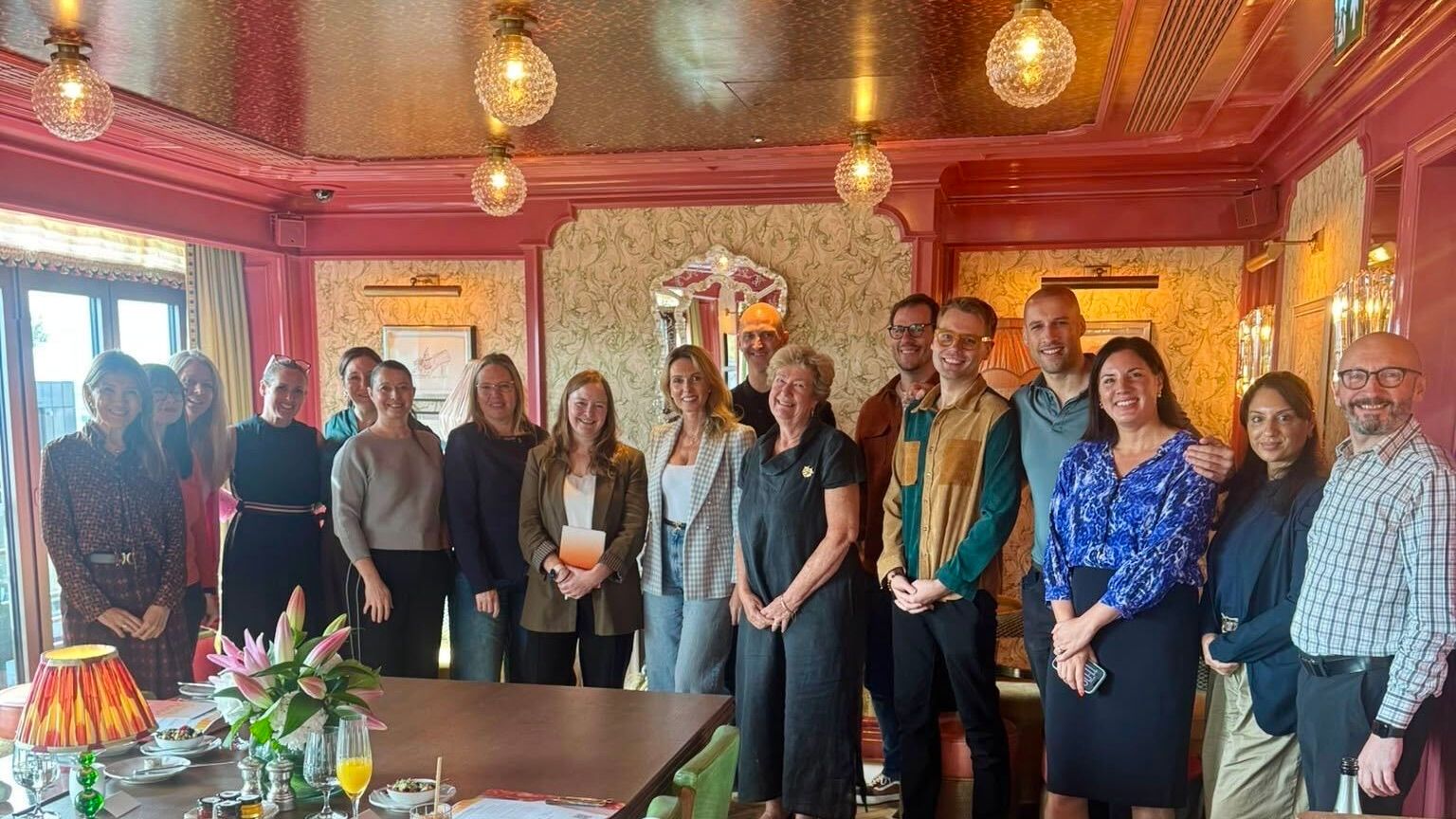
Off the Record is Ammunition's invitation-only roundtable series for senior marketers: the space to think out loud. Each session brings marketing leaders together around one focused topic. There are no presentations, no panels, and everything runs under Chatham House Rules. It's built for the conversations, the honest ones about what's working, what isn't, and where decision-makers are placing their bets.
September's session brought together senior leaders from manufacturing, SaaS, EdTech, professional services, consulting, and research, and the energy in the room showed how far the AI conversation has moved. We're past whether marketing will use it. The question now is what it does to the team, the work, and the value we create.
We’ve adopted AI faster than we’ve redesigned marketing around it
Before the session, 81% of attendees said exactly that, and the conversation quickly showed why it matters. Experimentation is happening everywhere, while roles, workflows, budgets, and accountability lag behind.
Scott Stockwell's RESHAPE framework offered a useful way through that tension by starting with the work rather than the org chart. Across its seven steps, Reinforce, Examine, Set, Handle, Aggregate, People, and Establish, it moves from strategy and what the brand stands for, through breaking roles down to decide what to automate or keep human, to bringing scattered AI use under control and treating the whole thing as a change program rather than an IT project. The thread throughout: understand what still needs doing, what AI changes and where human judgment adds value, then design the team around that.
Much of the conversation suggested organizations are accumulating tools and experiments while the operating model around them remains largely unchanged. We’ve seen versions of this before with CRM, automation and social media, but AI is accelerating the consequences.
Our take: Start from your north star, what the marketing is actually there to achieve, then design the work, the roles and the ownership around it. Headcount is the output of that, not the starting point.
Cheaper output doesn’t automatically create more value
This was one of the biggest debates of the morning. AI has made it extraordinarily easy to produce more work, but there was far less certainty that more work means better marketing.
Examples ranged from AI-generated creative that performed well in testing but damaged perceptions of quality, to polished AI-generated reports that became much less impressive when the person presenting them couldn’t explain what was actually driving the numbers.
One phrase captured the tension particularly well: “lazy is efficiency without purpose.” The opportunity isn’t simply to remove human effort, but to remove work that doesn’t deserve human time while protecting the thinking, judgement and craft that made it valuable in the first place.
That makes judgement increasingly important. AI can get us to a plausible answer remarkably quickly, but the advantage lies in knowing whether it’s the right answer, what’s missing and when the obvious answer is exactly the one to avoid.
Our take: Make quality someone's clear responsibility at every stage, with a standard AI has to meet before anything ships. If the person presenting it can't explain the number, it isn't ready.
Which makes brand and creativity more valuable than ever
The Growth Syndicate found that 63% of B2B marketers believe AI is adding noise and eroding differentiation, which chimed strongly with the conversation in the room.
When everyone can produce decent work easily, doing more of it stops being an advantage. What matters more is making something people notice, remember and choose.
That makes protecting brand, originality and craft a commercial decision rather than a sentimental defense of creativity. If competitors can reproduce your features, claims, content, and increasingly even the quality of execution, distinctiveness becomes more valuable precisely because sameness becomes cheaper.
Our take: Name what's genuinely yours, the voice, the assets, the point of view a competitor couldn't run unchanged, and protect it. Let AI take the rest. If you can't name it, fix that first.
The talent model has to move with the work
The clearest hiring view was a return to generalists. A decade of recruiting specialists, programmatic, search, digital, has built deep technical skill but left teams short on breadth, strategy and commercial awareness. The people worth hiring now can work across disciplines, judge what AI produces and connect it back to a business problem.
One leader walked through their own role audit: eight roles broken down to individual tasks, which surfaced heavy overlap, 42 possible use cases for agents, and the finding that 80% of tasks still needed a human involved. The clearest change was content moving from creation to governance.
The most sought-after hire was an AI expert with a marketing background, described as gold dust because the perfect CV doesn't exist yet. Those who had hired one interviewed for curiosity and evidence of tinkering, including what people had built in their own time, and one had carefully worked the job title, "marketing process and AI enablement manager," to attract the right person.
Others are growing the skill in-house through "AI black belts," people given 20-30% of their time to experiment. One had built an agent on top of their project-management system that the team can now update by chat. This only works with the culture to support it, tinkering needs enough safety to try things and get them wrong.
Several were also hiring for the human skills, ethics, quality and judgment, with interview questions as simple as "who influences you, which podcasts do you listen to," a proxy for genuine curiosity about the craft.
The harder question was at the junior end. If AI takes the entry-level work people learned through, where does the next generation build judgment? Someone remembered an intern who once named a brand a whole senior team couldn't, the talent is often already there, if there is a rung to stand on.
Worth stealing, two prompt tricks from the table:
- Ask Claude to review everything you have done over the last 30 days and turn the repetitive tasks into reusable skills. A real time-saver, and a clear picture of where your effort goes.
- After a long, rambling prompt, ask it what the most efficient prompt would have been. You get the sharp version back, and you learn to prompt better.
What to do: Hire for judgment, breadth and curiosity, name your tinkerers and give them real time to experiment, and protect the junior roles where judgment is learned. Automating them is cheap now and costly in three years.
The customer is still the point
As organizations race to find more places to use AI, the room raised a useful challenge: are we solving a customer problem, or simply finding a use for the technology? The distinction matters because customers rarely care what sits behind an experience; they care whether it makes something meaningfully better.
That puts a higher bar on where AI belongs. Efficiency alone isn’t enough if it removes something customers value, while some of the strongest applications may be almost invisible: resolving a problem faster, recognizing when an interaction needs a human, or removing administrative work so people can spend more time with customers.
Our take: Judge every AI project by whether a customer feels the benefit, not just whether it saves you time. Point it at what's broken for people, and keep a human where the moment needs one.
So, where does that leave us?
The useful through-line from the morning was that access to the technology is no longer the challenge. The real work is redesigning organizations around it without losing judgement, quality, distinctiveness or sight of the customer.
Adoption is already happening. The more interesting challenge now is working out how marketing becomes more valuable because of it.